Determining whether to add detailed risk management and contingency documentation to a project plan should depend on the severity and number of the risks and the probability of them occurring, and using a mathematical approach to making this decision is the most effective way to minimize overall project risk while reducing unnecessary documentation.
This article presents a mathematical approach to determine the optimal type of risk management documentation to include in a project plan. The following four steps outline this process.

Step 1: Identify the Project Risks
To begin, identify the risks associated with your project and list them as shown in the first column in Table 1 below, for example. The remaining columns will be completed in Step 2 below.
NOTE: If you feel that finding all risks upfront is not possible, then that itself is a risk and should be included in the table.

Step 2: Rate the Project Risks
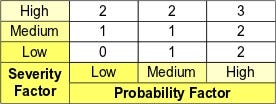
Once you have identified the risks, the next step is to fill-in the 2nd through 4th column of Table 1 by rating each risk’s severity and probability of occurring as High, Medium, or Low. Then assign each row its appropriate SPR (Severity/Probability factor Rating) value by referencing Table 2 and then, if you wish, sort the table by highest to lowest SPR value to signify those risks with the highest priority at the top. This table can be useful to show in the project plan.
Step 3: Calculate the Overall Project Risk
After rating the project risks and assigning their SPR values, find the overall project risk by calculating the root mean squared (RMS) of the SPR values. To calculate this value, use the SPR values from Table 1 in the following formula [1], where “n” is the number of risks.
Table 1 yields an Overall Project Risk value, or RMS of 1.5811.
Note: Using the RMS instead of just taking the average is important because it places greater emphasis on risks with a high severity and/or high probability of occurring, therefore increasing the need for more detailed project risk documentation in those situations.

Step 4: Determine the Project Risk Documentation
Once you have calculated the Overall Project Risk value, cross-reference it with the Overall Project Risk Document Requirements provided below in order to determine the most effective project risk documentation to be added to your project plan. Since this value is 1.5811 in the example above, then both a risk mitigation strategy and outlined risk contingency plan should be added.
Overall Project Risk Document Requirements [1]
3: Risk mitigation strategy and detailed risk contingency plan
2: Risk mitigation strategy and outlined risk contingency plan
1: Risk mitigation strategy
0: Treat as a project assumption
Conclusion
Adopting a mathematical approach to risk management documentation can help project managers more accurately assess and mitigate project risk without creating unnecessary project plan content that would otherwise divert attention away from the important project risks. This technique adds to the optimal mindset of assessing risks systematically. In this way, organizations can enhance their project planning and ultimately minimize potential adverse impacts.
References
[1] Royer, P. S. (2000). Risk management: the undiscovered dimension of project management. PM Network, 14(9), 31–39.