The global energy crisis and the imminent transition towards clean energy are compelling reasons to embrace new technologies capable of reducing energy consumption. Moreover, as government energy regulators continue to tighten their policies, IT companies may eventually reach the stage when their investments in energy-efficiency and in achieving carbon neutrality have a diminishing marginal return on the metrics that these regulators use to determine progress in this area.
In order to determine when this stage has arrived, regulators will require a period to establish a status quo with the IT industry to evaluate whether its carbon emissions align with their requirements. This assessment will most likely enable a deceleration or reduction in the escalation of emissions restrictions, but will it be too late to quickly restore economic growth if this status quo is realized too slowly?
This article analyzes the implications for the IT industry resulting from rising energy costs and legislative measures. It also examines the impact of a significant time delay between reaching near-maximum energy efficiency and regulators recognizing this achievement and subsequently easing their requirements.
As global energy prices remain high and geopolitical factors drive the shift towards energy sustainability, leading to more stringent emissions regulations, the range of energy-efficiency technologies and processes in the IT industry will continue to expand. However, this expansion may come at a cost if not implemented properly.
Reducing carbon tax
Depending on an IT company’s growth strategy, financial situation, and available resources, their journey towards achieving carbon neutrality and reducing their carbon tax may necessitate actions such as purchasing carbon credits, implementing price increases, temporarily halting growth [1], enhancing energy efficiency, and/or exploring sustainable energy sources. In the long run, striving for carbon negativity would be the most advantageous approach, as it would enable the company to accumulate, invest, or trade the surplus carbon credits generated.
NOTE: If a company takes a reactive approach to carbon regulations and does not create a long-term strategy for carbon neutrality, it could hurt them in the long run.
How would a company reduce carbon tax?
To minimize its carbon tax, an IT company has several options. It can purchase carbon offset certificates, invest in a sustainable facility infrastructure to reduce carbon emissions, upgrade energy-inefficient hardware if it operates its own data center, or enhance the energy efficiency of its software. When the risks and effort involved are minimal, prioritizing software efficiency would be a logical initial step. This approach offers multiple benefits, including faster execution speed, reduced memory and storage usage, and overall decreased hardware requirements. Additionally, the thorough analysis and re-factorization performed during this process would lead to a more precise estimation of future resource needs as scaling becomes a factor.
Future energy legislation may stall growth
As carbon regulations become stricter and advancements in software and hardware energy-efficiency technologies continue, IT companies will adapt their infrastructure accordingly. However, there may be periods of regulatory uncertainty where they hesitate to invest, or they may anticipate more stringent legislation that they lack the capital to meet, or have already maximized their efficiency (refer to time point A in Figure 1). These factors will hinder their growth, necessitate faster price increases, and incentivize them to explore other business areas with less stringent energy policies to generate carbon credits that can offset losses incurred from energy regulations.
In any scenario, software and hardware energy-efficiency technologies and processes will play a crucial role in an IT company’s success as energy costs rise. However, as depicted in Figure 1 below, their impact will initially grow rapidly but eventually taper off gradually.
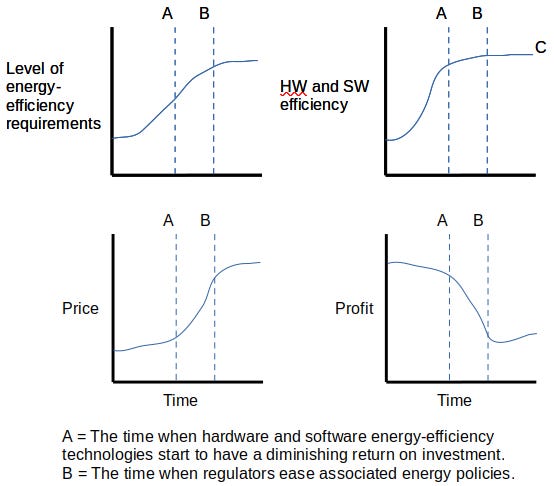
NOTE: Figure 1 makes the following assumptions:
- The start of the Time axis’ represents the time when energy legislation requirements are low.
- There is a time gap between A and B because energy policy regulators will need time to assess key industry-wide energy-efficiency metrics in order to assess that their targets have been met. This period of time will be dependent on when the aforementioned metrics are considered stable and non-transient , and when local, regional, and/or higher legislative bodies specify the necessity for policy easement.
- Supply/demand price equilibrium is always maintained. However, there is a high probability that a supply shortage could occur between point A and B, resulting in higher prices which may or may not find price equilibrium. This is because macroeconomic effects such as inflation could be a contributing factor at that time.
- Since IT industry energy-efficiency requirements will continue to increase between point A and B, IT companies will be forced to decrease supply in order to help decrease their carbon tax.
Edge computing and the expansion of local data centers
The Cloud landscape will continue to broaden and become more diverse as the IoT (Internet-of-Things) trend drives a horizontal expansion of cloud data centers, thanks to energy-efficient edge computing architectures that prioritize proximity to the customer premise. This shift will necessitate an increase in the number of edge micro data centers, in-sourced data center customers of large regional providers in various sizes, and IoTaaS (IoT-as-a-Service) providers catering to small and medium-sized businesses, as well as specialized requirements like ships with limited Internet connectivity and IoT sensors. AWS Snowball [2] is one such edge computing product designed for low-connectivity applications, including ships.
However, the growing demand for data centers presents challenges. Regulatory pressures, focused on energy sustainability, may lead some local governments to limit data center expansion due to concerns about increased electricity demand hindering their own carbon reduction targets. Retrofitting older data centers to meet new sustainability requirements can be costly and risky, resulting in retirement and potential supply shortages [1]. The impact of these challenges will be most pronounced between points A and B in the timeline depicted in Figure 1.
NOTE:Regulatory pressures may cause local governments to limit data center expansion due to restrictive carbon reduction targets.
Considering these circumstances, the success of local data centers and other power-intensive infrastructures will depend on energy legislators’ understanding of the regional status quo affected by their policies. This inherent risk will most likely constrain or undermine the growth strategy of some companies, leading to investor concerns if unexpected regulatory changes occur or if regulatory uncertainty becomes prevalent in the industry.
Conclusion
The momentum towards energy efficiency in data centers is gaining pace, and the sooner companies enhance their understanding of the relevant technologies, the more effectively they can develop contingencies to manage the risks imposed by government energy regulators. The delay in regulators collecting and analyzing historical data, establishing a status quo, conducting audits, assessments, and adjusting energy limitations for high-energy users like data centers can pose a substantial risk that may negatively impact company investments, growth planning, pricing, and profitability.
References
[1]: Kelly Morgan, Filippo Bonanno. June 8, 2022, Sustainability is no longer a ‘nice to have’ for the data center industry, https://www.spglobal.com/marketintelligence/en/news-insights/research/sustainability-is-no-longer-a-nice-to-have-goal-for-the-data-center-industry. accessed on 2022–06–25.
[2]: Amazon Web Services. “AWS Snowball. Accelerate moving offline data or remote storage to the cloud.” https://aws.amazon.com/snowball/, accessed on 2022–06–23.